Access All Areas: The Road Ahead — Reflections from the Queensland Disability Conference 2026
On Friday 11 September 2026, Queenslanders with Disability Network (QDN), in partnership with the Queensland Department of Families, Seniors, Disability Services and Child Safety, hosted the Queensland Disability Conference 2026 online, under the theme "Access All Areas: The Road Ahead." The free event brought together government, industry, sport and disability advocacy voices to talk through disability reforms, accessible transport, and one of the biggest forcing functions on the horizon for Queensland: the Brisbane 2032 Games.
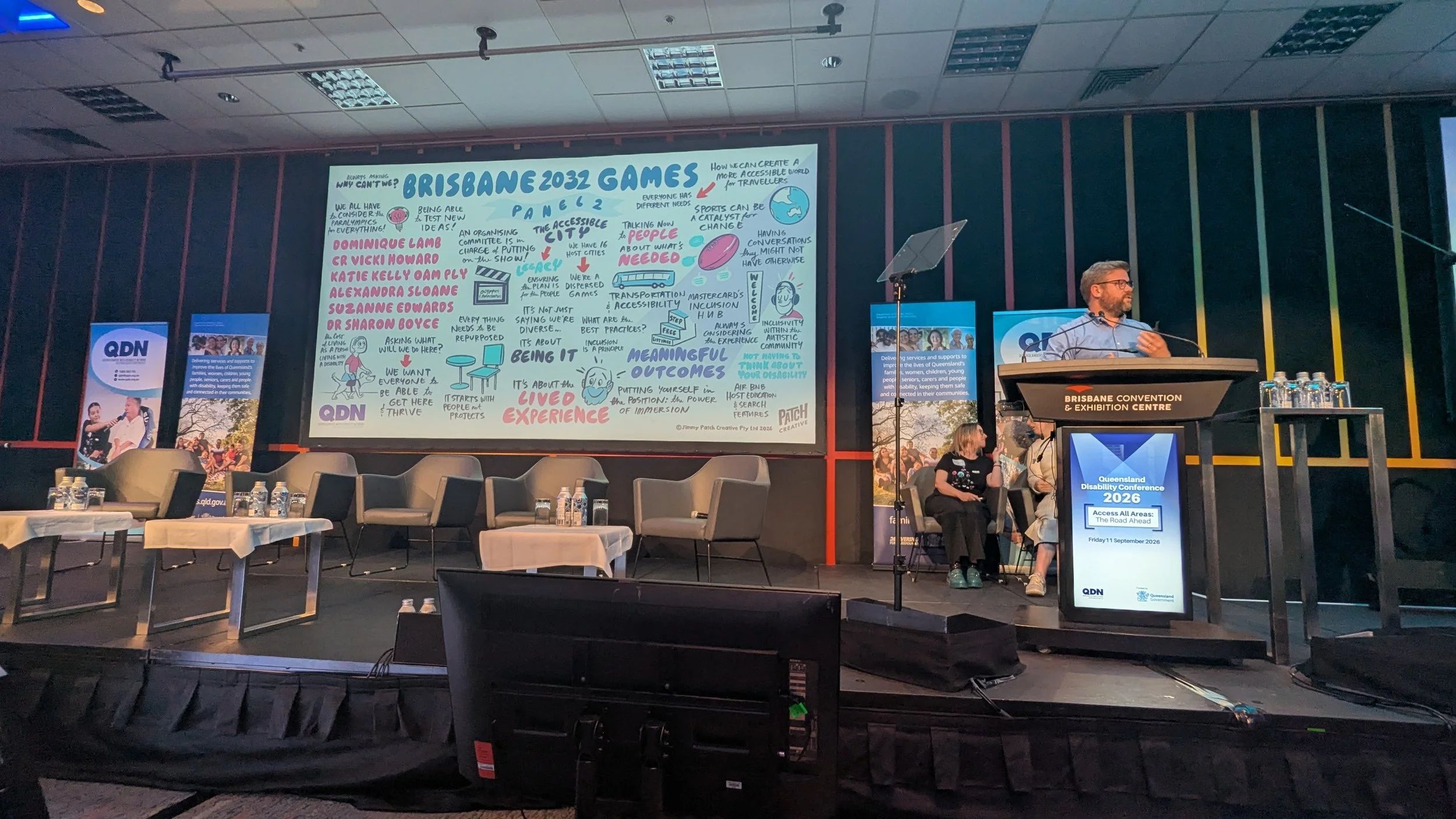
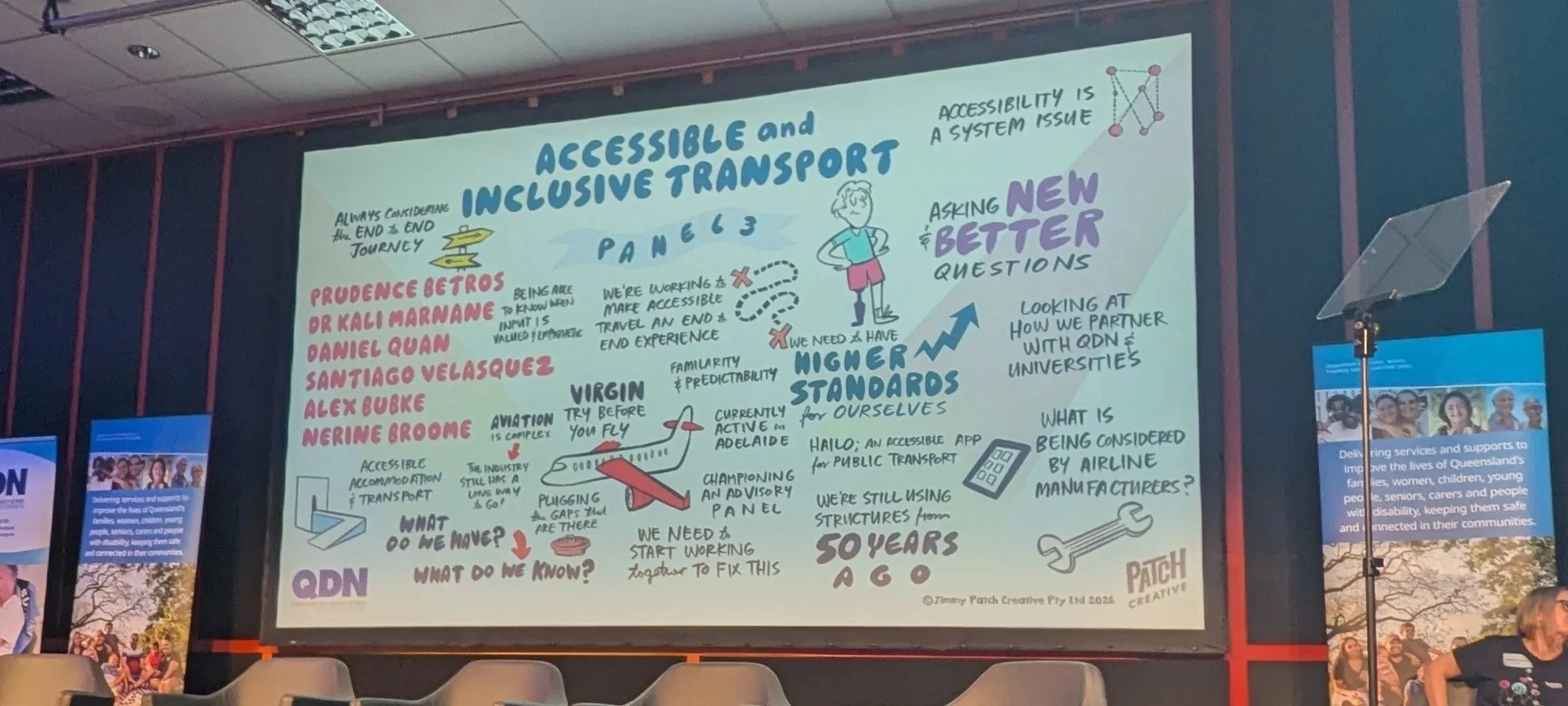
Below is a recap of two of the day's panel discussions, on the social and economic impact of the Games, and on turning lived experience and technical expertise into genuine inclusion outcomes. I particularly loved Jimmy Patch’s live graphic and dot-point highlights of the talks in real time!
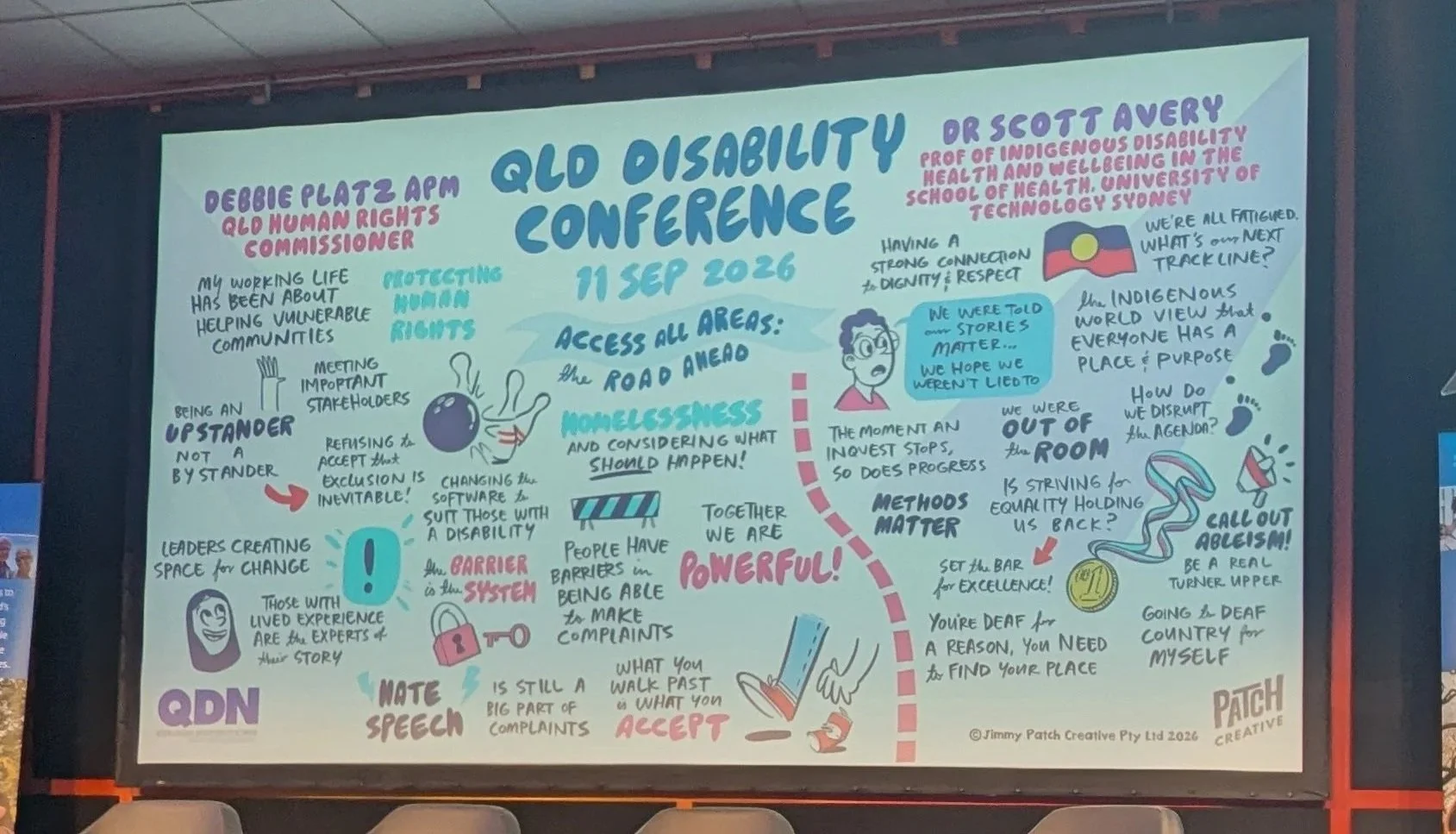
Panel 2: Brisbane 2032 Games — Social and Economic Impact
With 16 host cities across the state, this panel opened with a reminder that Brisbane 2032 is a dispersed Games, and that accessible infrastructure and transport will matter as much as the venues themselves.
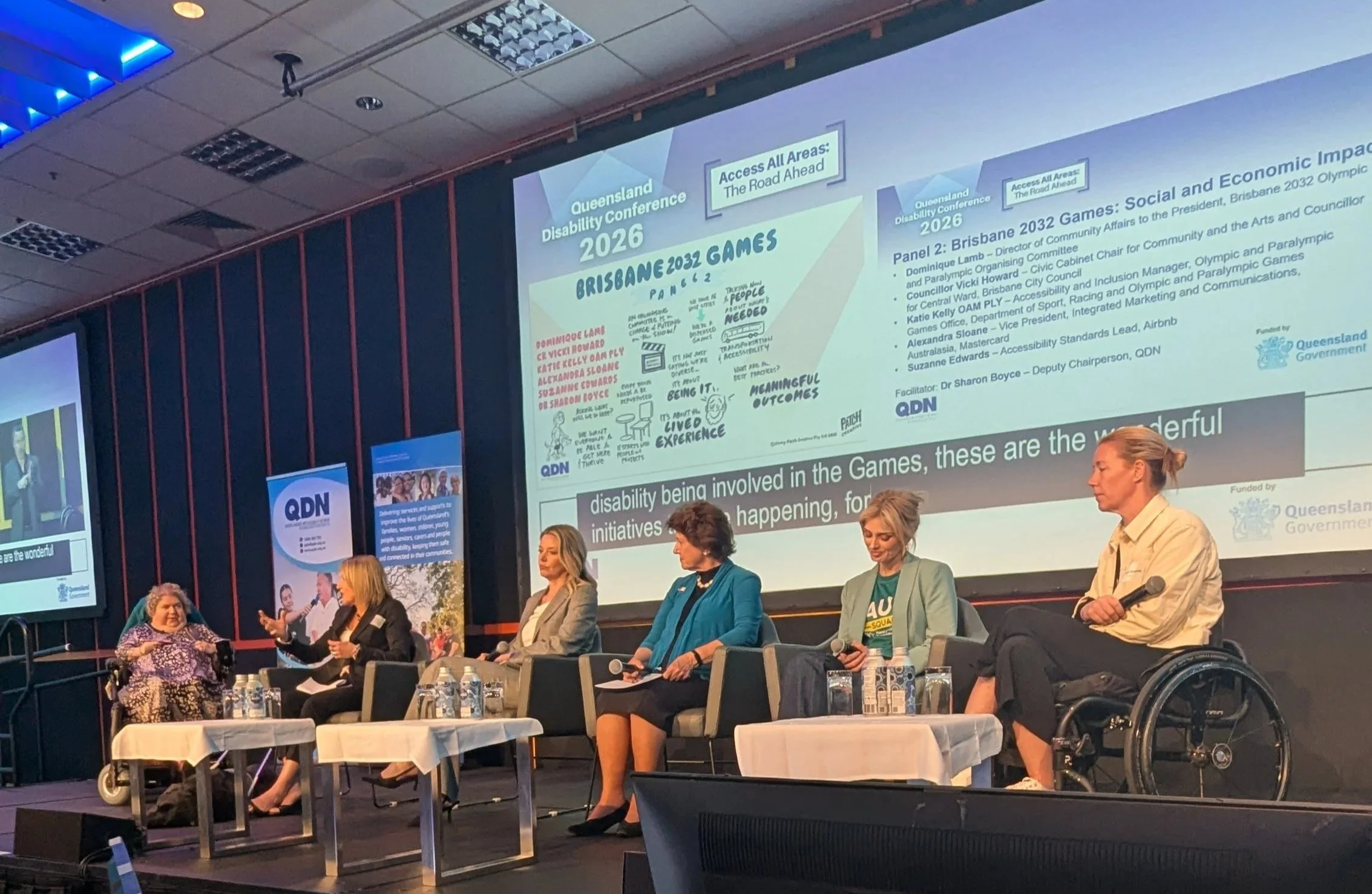
Sharon, Katie, Alex, Vicki, Dominique, and Suzanne in conversation at the Queensland Disability Conference
Dominique Lamb (Director of Community Affairs, Brisbane 2032) framed the Games as a catalyst for conversations that might not otherwise happen, pointing to workforce diversity, inclusive procurement, and planning for what happens to Games infrastructure afterward. She highlighted how incredible Queensland’s natural environments are, and how everyone should have the chance to experience them.
Cr Vicki Howard (Councillor, Brisbane City Council, representing Lord Mayor Adrian Schrinner) said "planning starts with people not projects," pointing to the Inclusive Brisbane Plan, Brisbane Metro, and the city's new braille trails as examples of accessibility built into infrastructure from the outset.
Katie Kelly (Accessibility and Inclusion Manager in the Olympic and Paralympic Games Office, Department of Sport, Racing, Olympic and Paralympic Games) argued that genuine collaboration means lived experience at the table from the start, not consulted after the fact, and said "inclusion is not a program, it's a principle."
Alexandra Sloane (Vice President, Integrated Marketing and Communications, Australasia, Mastercard) explained Mastercard's interest in the room: inclusion sits in the company's mission statement, and sport is a proven accelerator for conversations that support it, as detailed in Mastercard's Starting Line report.
Suzanne Edwards (Accessibility Standards Lead, Airbnb) spoke to the scale of the opportunity in accessible travel, citing Airbnb's growth in step-free listings ahead of the Paris Games as an example of what a Games can do for accessible accommodation.
Panel 3: Turning Lived Experience into Policy
The third panel focused on what it takes to move from good intentions to genuine outcomes.
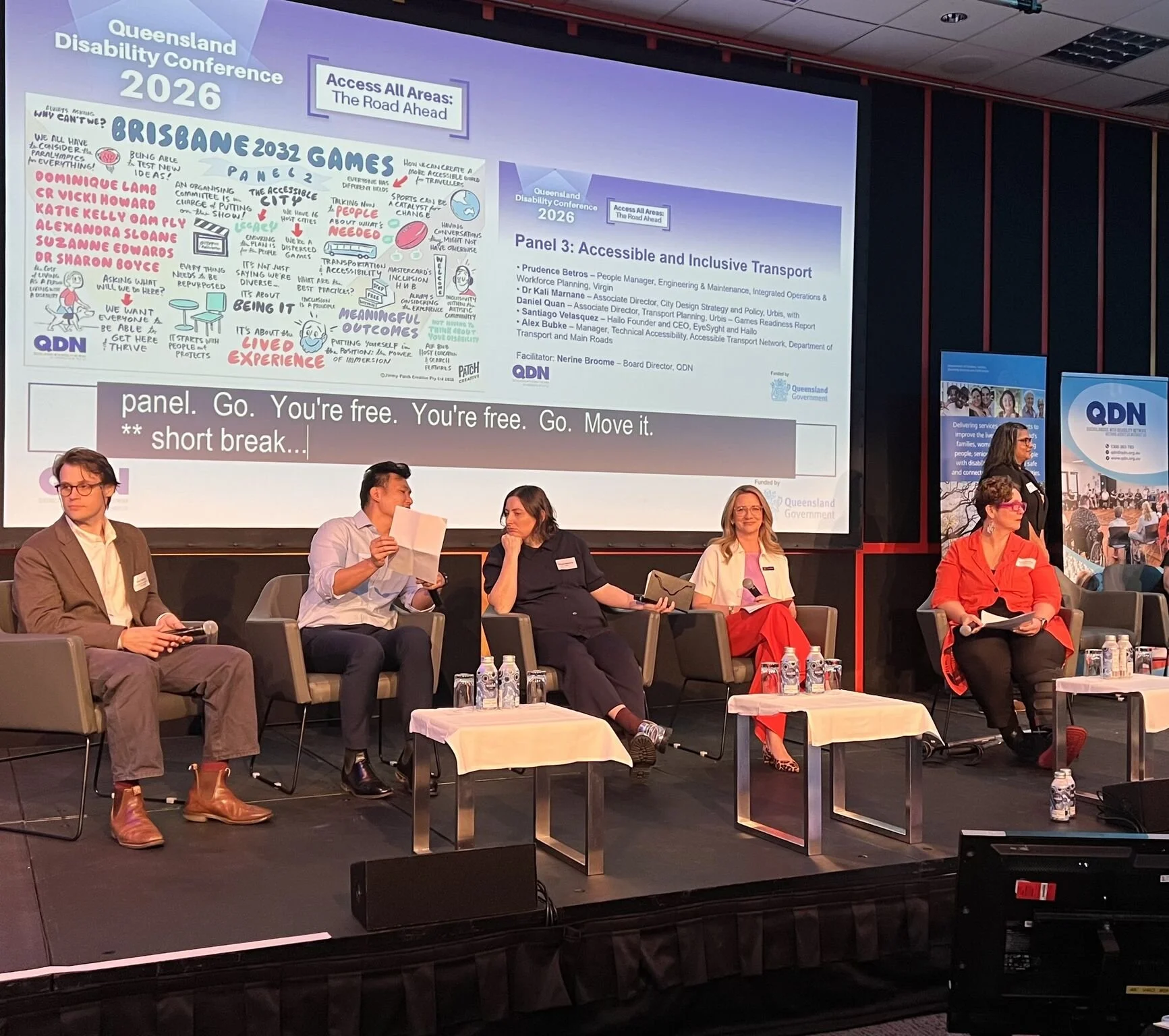
Alex, Dan, Kali, Prudence, and Nerine preparing for their panel during a short break
Prudence Betros (People Manager, Engineering & Maintenance, Integrated Operations & Workforce Planning, Virgin) spoke about Virgin's work trialling flight simulation, a "try before you fly" approach designed to support people with disability ahead of their travel, and her personal disability journey with her blind son.
Santi Velasquez (Co-founder and Chief Technology Officer, Hailo) argued that lived experience needs to be combined with technical expertise, so that decisions are grounded in evidence rather than opinion, and made the case for supporting policy makers in that work rather than simply criticising from the outside.
Dr Kali Marnane (Associate Director, Urbis) - I shared the work we’ve been doing with QDN on how Games ready we are in terms of accessible transport and hotels, noting that our main finding is that we’re ready in parts but not yet as a system. We know how to deliver physical infrastructure well but we need to coordinate across compliance silos, integrate existing older infrastructure, and support attitude change.
Dan Quan (Associate Director, Urbis) shared more about our Games Readiness report, and that good transport planning starts by recognising that people experience places as connected journeys, not as individual pieces of infrastructure. The biggest opportunity right now is to focus on end-to-end journeys and plugging the gaps in connectivity.
Alex Bubke (Manager, Technical Accessibility, Department of Transport and Main Roads) picked up the theme of equity directly, noting that while accessibility benefits everyone, there are specific cohorts who are distinctly disadvantaged, and that public transport investment needs to target that disadvantage specifically rather than assume a rising tide lifts all boats.
It was inspiring to be part of the conversation about all the exciting initiatives being worked on across Queensland to improve our state.