Last night we launched the Games Readiness: Queensland Hotel and Transport Accessibility report developed by Urbis in partnership with Queenslanders with Disability Network (QDN).
The Games Readiness report examines the current state of accessible accommodation and public transport across Brisbane, the Gold Coast and Cairns through a combination of accommodation audits, transport analysis, and 79 real-world journeys undertaken by people with diverse disability.
As Queensland prepares for the Brisbane 2032 Olympic and Paralympic Games, the conversation is increasingly shifting from whether accessibility matters to how we deliver it at scale. The Games provide a deadline, but the legacy is the real opportunity. Our vision is for Queensland to deliver a truly welcoming Games that builds a legacy where everyone belongs, with accessibility embedded across information, transport, accommodation, and service as a connected system.
The Games Readiness report reveals that Queensland is not starting from scratch. We have many examples of excellent accessibility. The challenge is that they do not yet operate as a connected system.
Accessibility is a systems challenge
Our Games Readiness report focused on transport and accommodation, but the findings have implications far beyond tourism. One of the strongest insights from our work was that people experience places as connected journeys, not individual pieces of infrastructure.
During the study, we documented 79 real-world journeys undertaken by 22 people with diverse disability across Brisbane, the Gold Coast and Cairns. Participants showed us that accessibility is about much more than whether a ramp exists or whether a lift complies with a standard. They spoke about:
confidence,
independence,
fatigue,
sensory overload,
safety,
belonging,
travelling alongside family and friends,
knowing where they are and where they need to go.
When once piece of the journey fell apart (for example, a lift being out of service or not being able to sit with family and friends at a venue), the whole journey experience fell apart. Accessibility works like a relay race. Every handover has to work.
A world-class venue does not matter if someone cannot get from the train station to the front door. An accessible hotel room does not solve the problem if it cannot be found online. A compliant bus stop does not create inclusion if people cannot walk or wheel between the bus stop and venue.
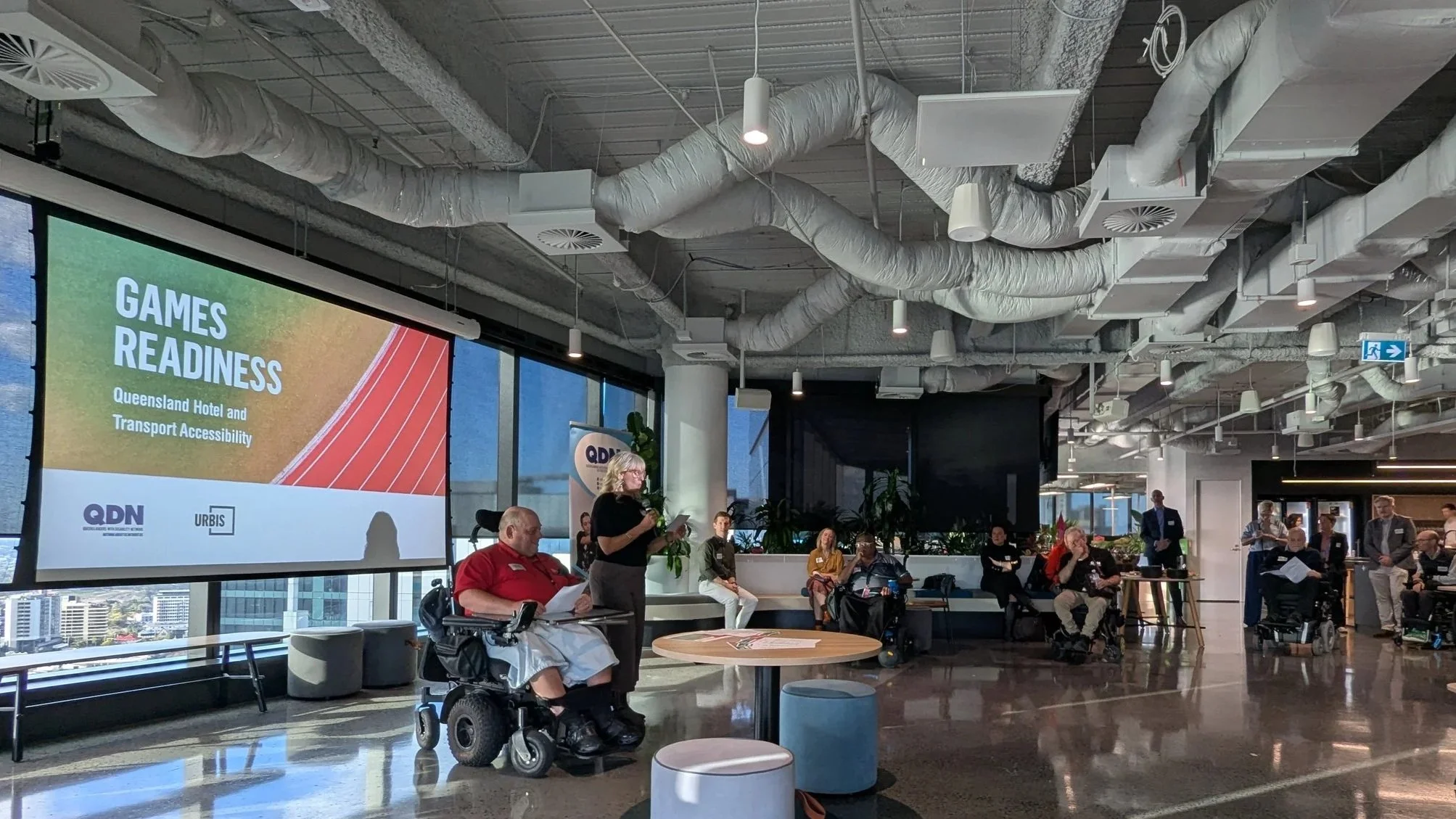
Nigel Webb and Nina Carr reflecting on their experiences undertaking journeys across Brisbane for the Games Readiness report at the launch in the Urbis office on 17 September 2026
We found more than infrastructure challenges
Perhaps the most surprising finding was that some of the biggest barriers were not major infrastructure projects. We actually know how to deliver accessible places (physical infrastructure) really well! The difficulty is in connecting new and old infrastructure and plugging the gaps in:
information,
wayfinding,
reliability,
journey planning,
staff capability,
confidence.
Many participants encountered uncertainty before they arrived at their destination. Where do I board? Can I trust this information? Will assistance be available? What happens if something goes wrong? These are not always billion-dollar infrastructure questions. Often they are service design, information design and customer experience questions that require collaboration across disciplines.
As Nigel Webb (QDN Board Member) observed at the report launch, "information must be part of accessibility." One of our case study participants Jennifer explained, "Don’t tell me something is accessible. Tell me what is there and I can decide for myself if it works for my situation.”
These seemingly simple statements capture an important shift in thinking. Accessibility is not only about the built environment. It is also about the information, systems, and services that allow people to use it, and the participation it unlocks.
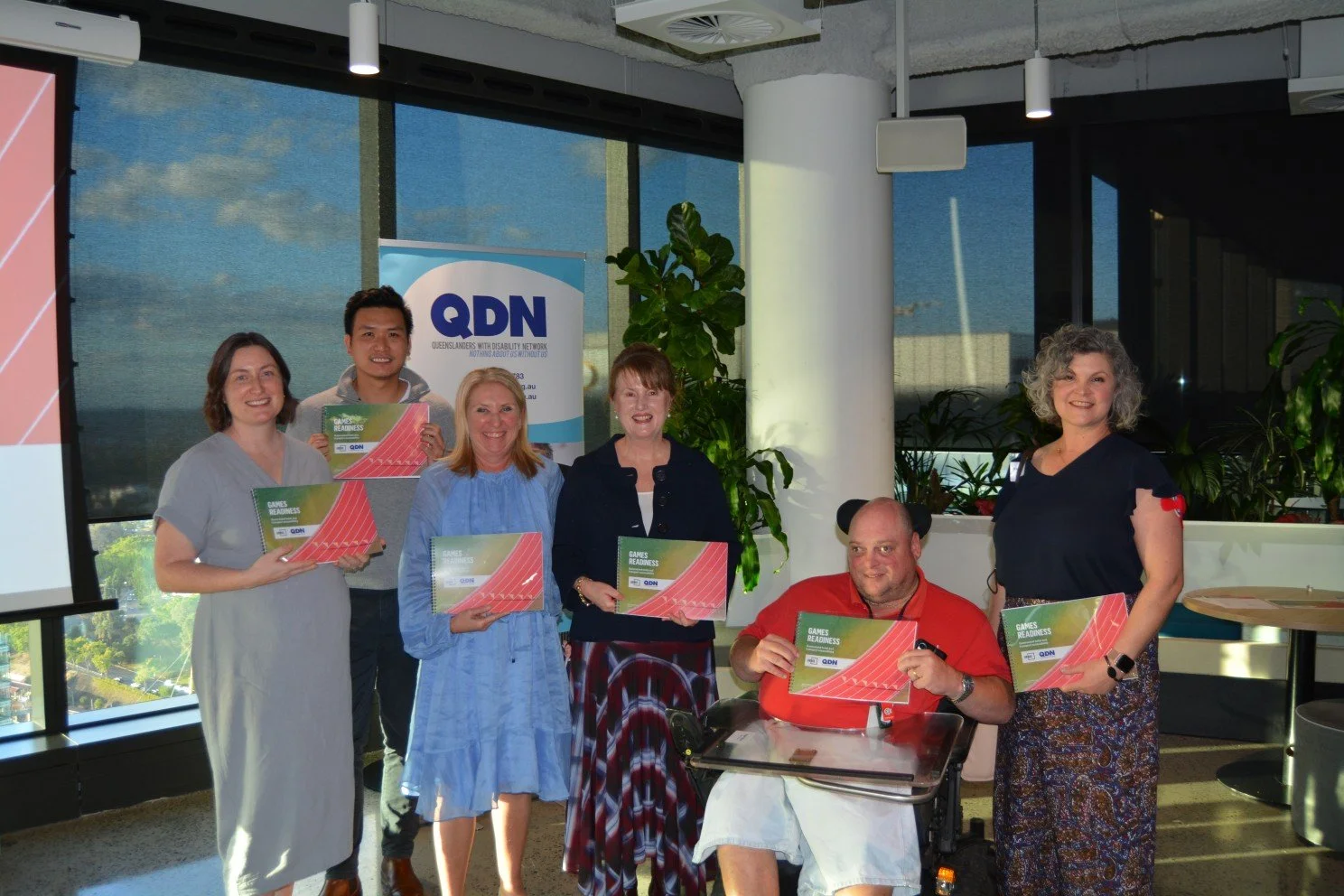
Games Readiness report authors Dr Kali Marnane and Daniel Quan (Urbis) with QDN CEO Michelle Moss, QDN Board Chair Dr Talitha Kingsmill, and QDN Board members Nigel Webb and Karan McCarthy at the Games Readiness report launch
Where to from here?
The Games Readiness report identifies six priority opportunities:
Standardise accessibility information.
Increase accessible accommodation supply.
Enable end-to-end journeys.
Strengthen journey information.
Build frontline capability.
Set inclusive standards.
Taken together, these recommendations point toward a bigger ambition to create a Queensland where accessibility is embedded into everyday life: where everyone can participate with confidence, travel independently, and, importantly, feel they belong.
Queensland's welcoming culture is one of our greatest strengths. The opportunity in front of us is to ensure our public spaces, transport, accommodation, information, and public attitudes, consistently reflect that welcome for everyone.