You can watch the forty-sixth Parlour LAB here!
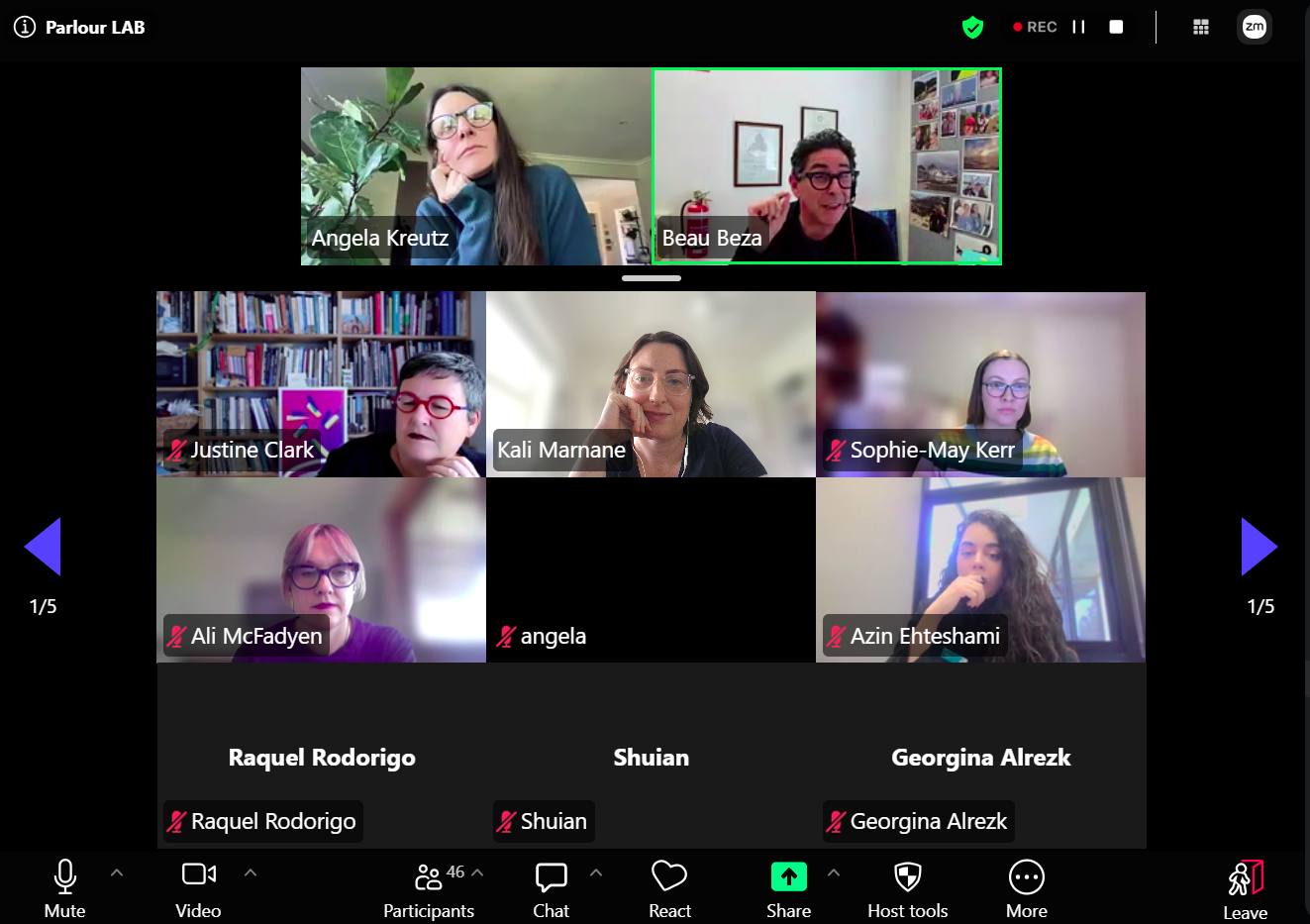
Young people are often positioned as future citizens, as though their experiences only matter later. This session pushed back on that framing directly: their experiences matter now, and the built environment shapes those experiences in ways that are easy for the rest of us to miss. Alison McFadyen and I were joined by three great speakers.
Dr Sophie-May Kerr (Research Fellow at UNSW’s City Futures Research Centre) researches the experiences of families raising children in apartments, and what design, reform, and policy could do to better meet their needs.
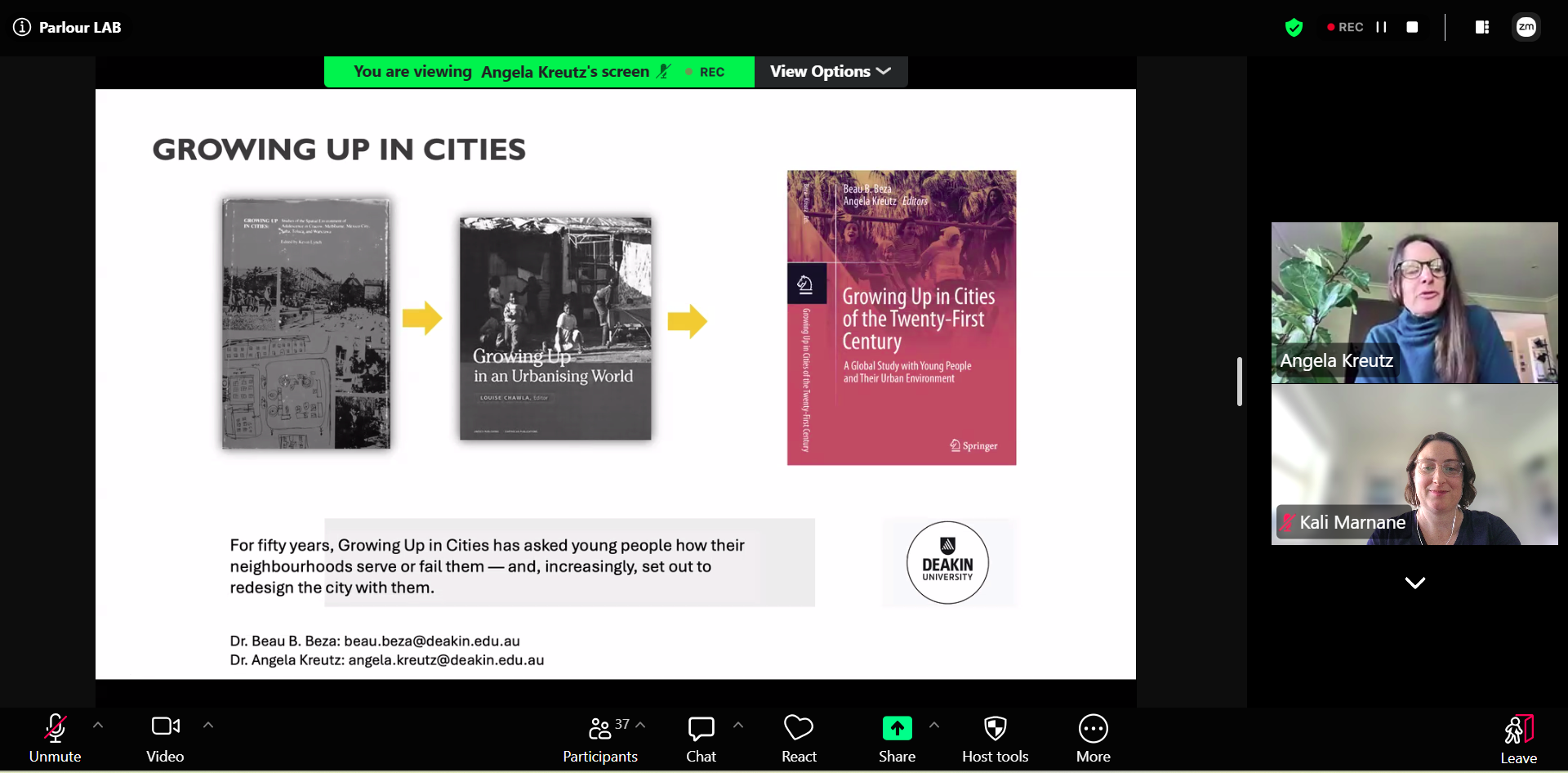
Dr Angela Kreutz (Senior Lecturer in Architecture and Built Environment at Deakin University) and Associate Professor Beau Beza (Associate Professor in Architecture and Built Environment at Deakin University) are working on the third iteration of a global research program examining how neighbourhoods serve, or fail, young people.
Here are some of the key things I learned:
Families in apartments
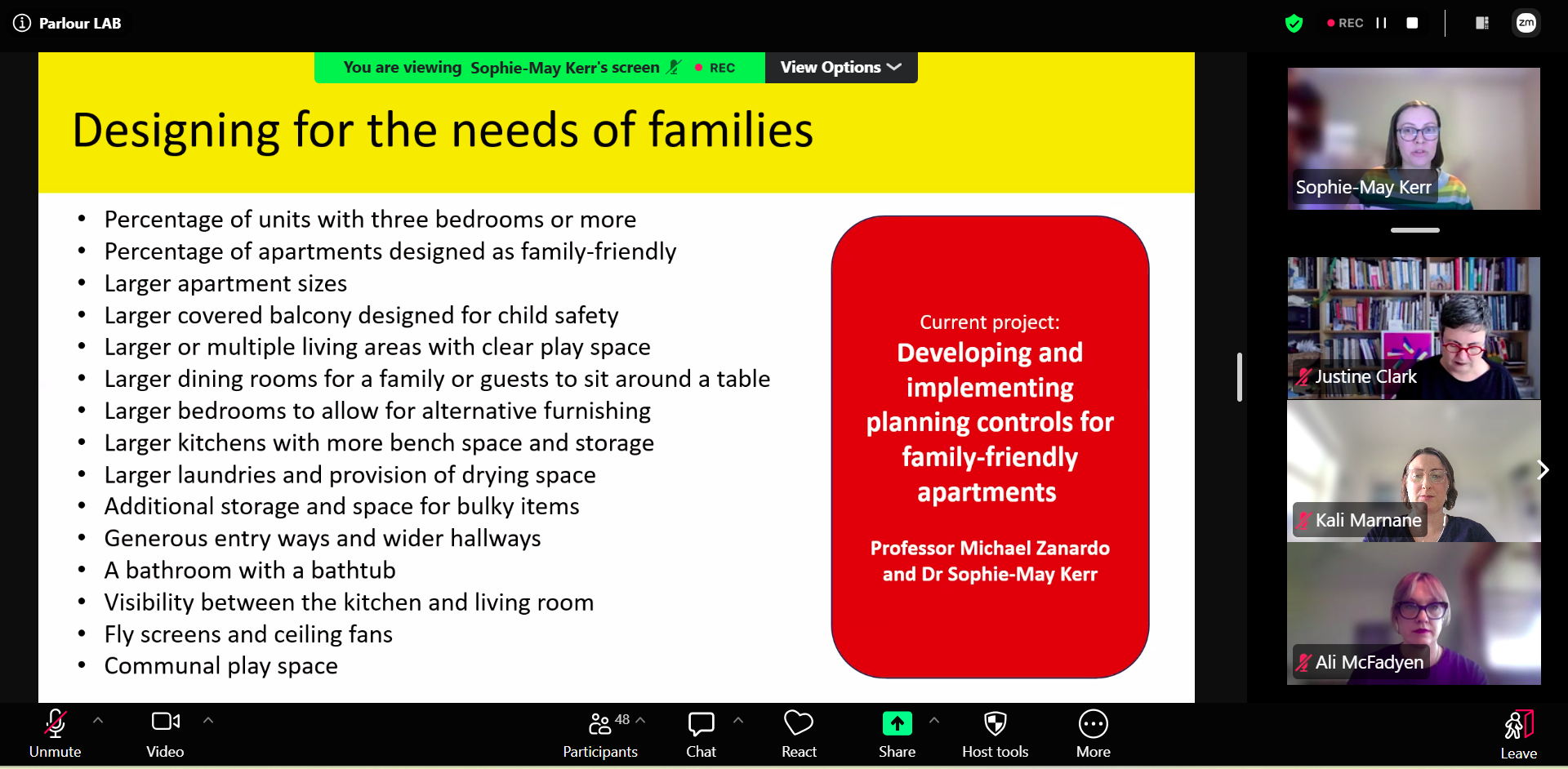
Sophie-May's research looks at what happens when apartments, largely designed without families in mind, become home for children anyway. Around 80 percent of apartment stock is one or two bedrooms, which puts a hard ceiling on what families can do.
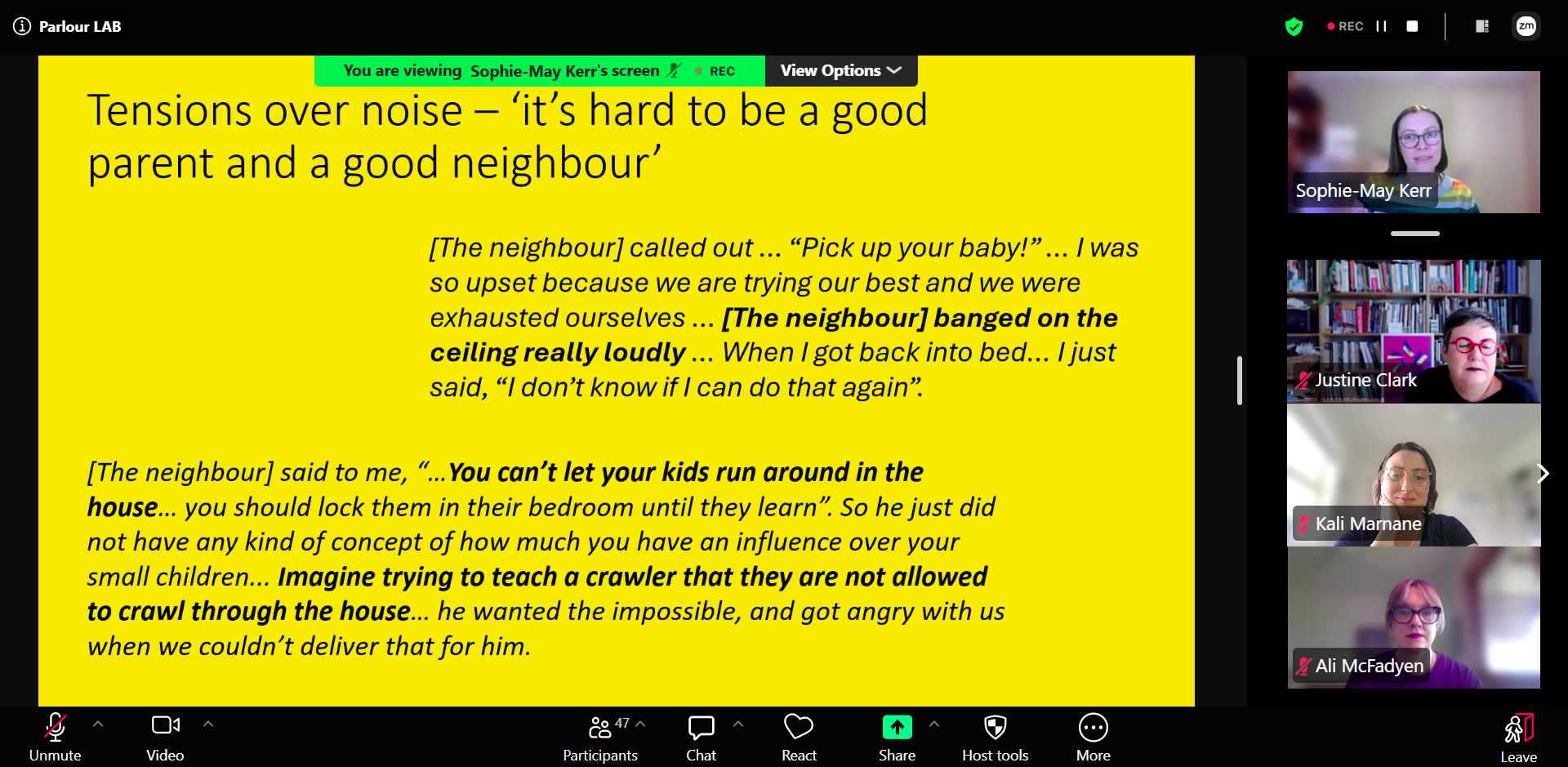
Poor acoustic performance creates tension between neighbours and adds a real source of stress for parents. Storage is often inadequate for the reality of family life, prams and boxes included.
Communal space rarely accounts for families either, and there are genuine health and safety questions around windows, bathrooms, and other basic features.
Cultural norms about what the “right” dwelling to raise a family can also position families as out of place in apartment buildings, with parents questioned about whether they belong there at all.
Families develop complex strategies to work around all of this, but there is only so much an individual household can change on its own. This is happening at exactly the moment cities need to encourage more people into denser living.
A global lens on growing up
Angela and Beau's project has found young people have consistent needs across global contexts (a sense of safety, a sense of belonging, independent mobility, and contact with nature) even though what meets those needs looks very different depending on the local culture and built environment.
Braybrook in Melbourne has been part of each iteration of the three Growing up in Cities studies, allowing the team to track how the same urban fabric evolves, or does not, in how young people actually use it. New parks and a dedicated youth team have been part of that evolution.
Digital life, hybrid spaces that move between virtual and real, climate change and environmental degradation, and parental fears all shape how young people experience a neighbourhood.
The researchers ground their work in the Convention on the Rights of the Child, Article 1 as a conceptual foundation for how designers think about young people.
Belonging and flexibility
Sophie-May kept returning to the word belonging. Apartments are no longer a stepping stone toward an eventual detached house; increasingly, people live in them across an entire life stage.
With less individual space, families lean more heavily on communal and public space, which means designers need to think carefully about how children and families will actually use those areas.
The mentality apartment design works from needs to shift too, treating apartments as permanent homes across different life stages, with space to play, space to store things, and room for needs that keep evolving. Three or more bedroom apartments remain a major barrier for many families, and larger spatial dimensions are genuinely needed, not just more bedrooms on paper.
For Angela and Beau, design characteristics are only part of the story. Equally important is the process of engaging young people in the first place, and building a mindset of inclusion into how that process runs.
Good public space reflects an identity back to the people who use it: murals, furniture that can be moved, spaces that are never fully finished so they can be adapted by those using it and shift with the times. Community gardens, climate action, and native planting all featured as examples.
The concept of "place" does not translate cleanly across cultures. In parts of South America, "territory" worked better as a concept, since it allows for expansion and contraction across different life stages. Context matters at every scale from micro to macro to meso.
Questions from the room
One audience question asked whether apartments need more zoned, closeable areas or more open plan living, and whether a "third space" should be flexible enough to be either. The panel's answer leaned toward flexibility and larger spaces: minimum standards should not constrain too tightly, and even the idea of a third bedroom might be better reconsidered as something like a 2.5 bedroom option.
Another question compared public and social housing to private market housing. Beau pointed to research in Chile where nature was effectively invisible in social housing complexes, since outdoor environments were never part of the design and residents had no real way to get outside.
On the economic cost of not engaging young people in design, the GUIC III book includes a set of highlights practitioners can translate directly into design decisions: responsive urban spaces that respond back to community needs, a shift away from the fear of families spending more time indoors, and nature treated as a limitless resource for young people to develop skills and negotiate space. Letting young people exercise territory was raised as part of this too.
There is a wide body of participatory action research methods available for engaging young people, and the panel encouraged designers and researchers to become genuinely youth aware and to advocate for their inclusion, rather than falling into the habit of defining spaces by age bracket instead of by the opportunities they afford.
Key takeaways from the speakers:
Angela: Listen. We are designing for someone, for a community, and doing that well starts with listening.
Sophie-May: Design age-inclusively. compact city living is becoming a life-long reality for many people, whether by choice or constraint, and what we design now will last. Those spaces need to work across a whole life, not just one stage of it.
Beau: Treat young people as capable agents of change. Their recommendations tend to benefit the whole community, not just themselves.
Justine noted that in constrained development circumstances, especially with no scope for engagement, existing research can help advocate for better policy, planning, and design outcomes. The third iteration of Growing Up in Cities will be published in December.