Who are we actually building for? Four ideas from today's symposium on housing
At The Architecture Symposium: Designing for the 99% held in Melbourne, I had the privilege of sharing some thoughts on design strategies for households whose lives don't match assumed lifestyles housing is often designed around. Thank you to Katelin Butler and Georgia Birks at Design Speaks for including me in a stellar line up!
The symposium surfaced many ideas from the room full of architects, developers, and researchers wrestling with questions like: who is housing actually for, and how do we make good design accessible and affordable?
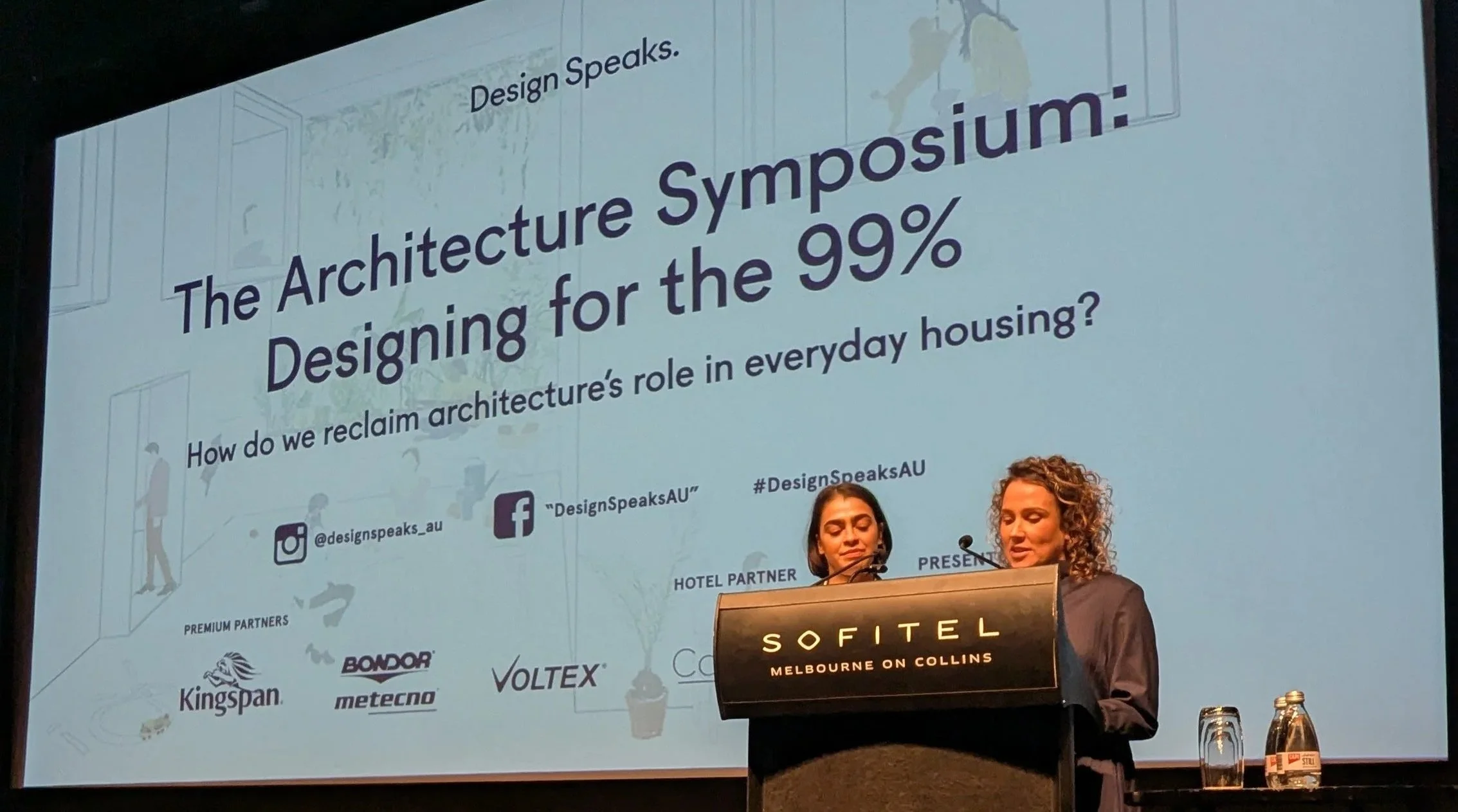
Georgia Birks and Katelin Butler opening The Architecture Symposium on 04 September
Here are four of those ideas that resonated with me:
1. "Homes are where lives unfold"
James Henry from Housing Choices Australia opened his session with a song recommendation, Ron Sexsmith's Camelot Towers, about mass produced housing built without love. His point was that social and affordable housing can become soulless when it's managed purely through metrics. Operating at scale is necessary for economic gain and to increase supply, but it can't come at the cost of losing sight of the human stories inside the buildings.
It's a simple but important line that, I think, captured the tone and sentiment of the symposium. Good design and good operation are, as he put it, the same thing. A building that performs well on paper and fails the people living in it hasn't succeeded.
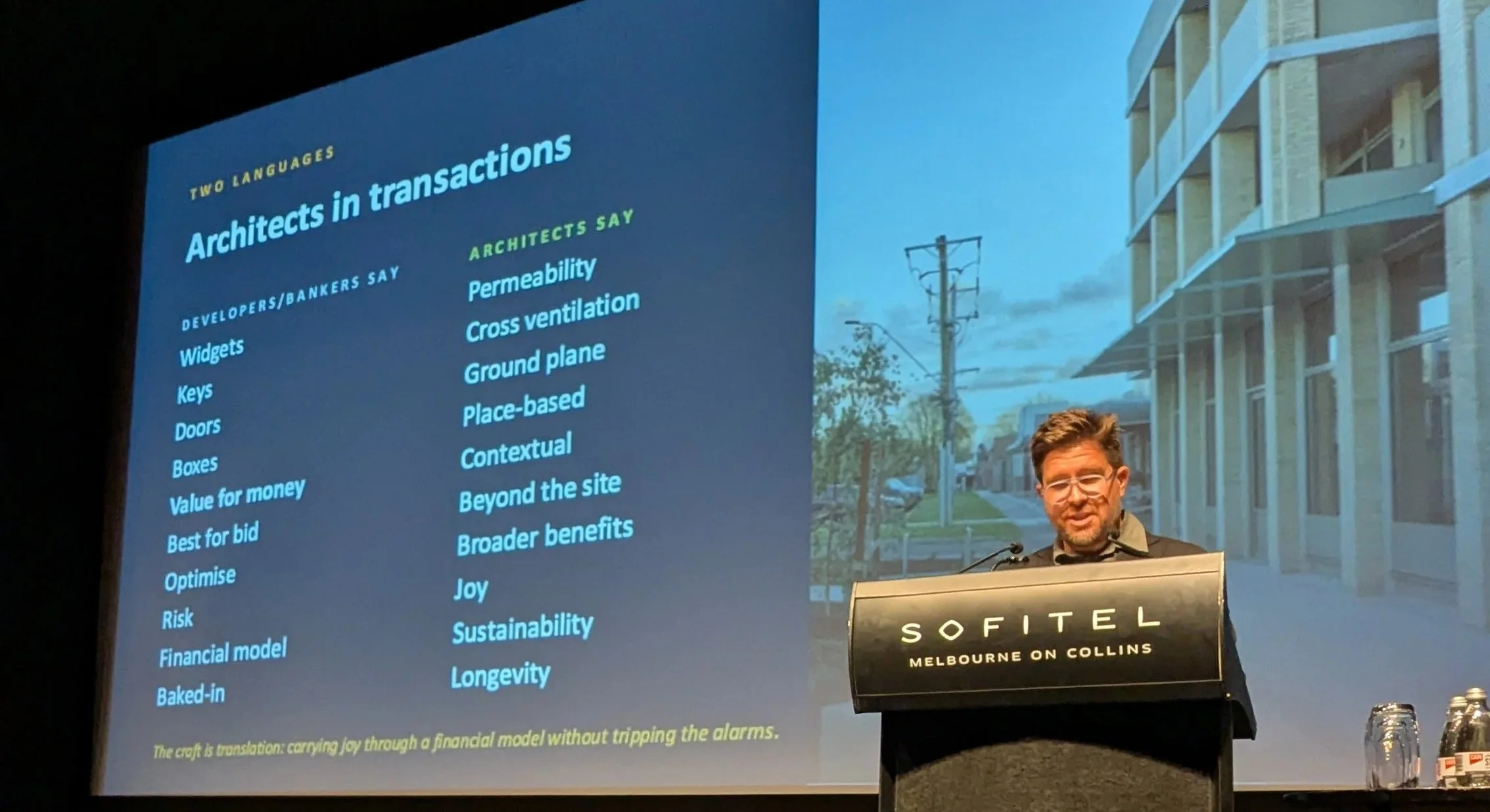
James Henry at The Architecture Symposium
2. We have the most leverage at the briefing stage
This was the point I made in my presentation. When we make assumptions about how people live and get them wrong, residents pay for the mistake in social, economic, health, or cultural costs that show up over the life of the building. Additional causalities are community housing providers that wear the cost of maintenance down the line from designs that do not match people’s lifestyles or poorly specified materials and health hardware.
I unpacked two core ideas central in housing design that we often make assumptions about: family and care. Family and household are diverse, defined differently by different people, and they change over time. Care work is often relegated to the sidelines as something cute and/or easy but in reality it is gory, difficult, critical to a functioning society, and needs spatial presence.
Whose household model does the brief assume? Who was consulted before the design started? What happens after occupation? The designer has real influence over how a brief and its underlying assumptions get interrogated before a pencil touches paper. That's where the leverage sits, before drawings lock in assumptions based on inappropriate cultural norms.
In a conceptual way, this linked to the conversation between Jeremy McLeod of Breathe (Melbourne), and Oscar Stanley of LAWD Development Advisory (Melbourne) on the challenges of volume housing. They noted the inverse relationship between dwelling and household size over time in Australia (from 3.6 people/100sqm house in 1950 to 2.5 people/235sqm house in 2025!) and the absurd rise in enclosed double garages dominating streetscapes (almost equal space for people and car in some examples!) that needs to be reset. They ran through the numbers of what middle-income households in Melbourne can actually afford ($692/week mortgage repayments or $525,000 house and land package) and how they’re designing a new masterplanned estate to account for this: car parking removed from the house and positioned around the edges of the development (noting that in the future individual car ownership will most likely be limited in favour of car sharing), 100sqm 3-bedroom townhouses on 125sqm of land - all designed within a forested setting with a high level of shared amenity.
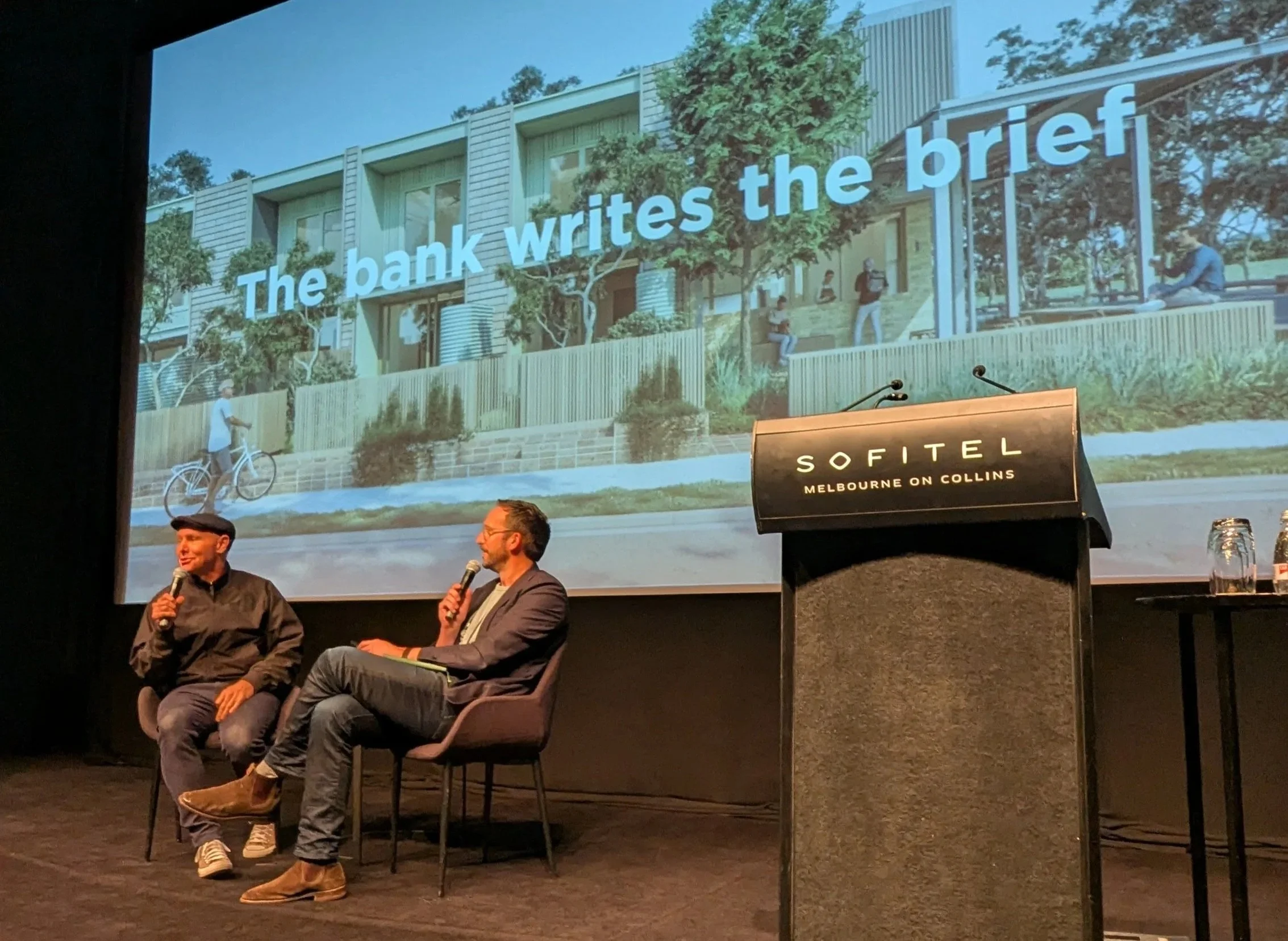
Jeremy McLeod and Oscar Stanley in conversation at The Architecture Symposium
3. Small, specific design decisions carry outsized weight
Emily Taylor from Core Collective Architects spoke about designing crisis accommodation and transitional housing for women and children escaping domestic violence, drawing on trauma informed design principles by Dr Samantha Donnelly. She described particular and precise details that mattered: a window seat designed so residents can see out without being seen from the street, a round window set above eye height in a bedroom to remove the risk of someone finding it at night, soft curves on edges so a frightened child moving through the space at speed doesn't get hurt, a lock with a red or green indicator so a resident can check at a glance that they're safe.
None of this is expensive in the way "good design" is sometimes assumed to be. It's specific, considered, and it comes from actually understanding who will live in the space and what they need.
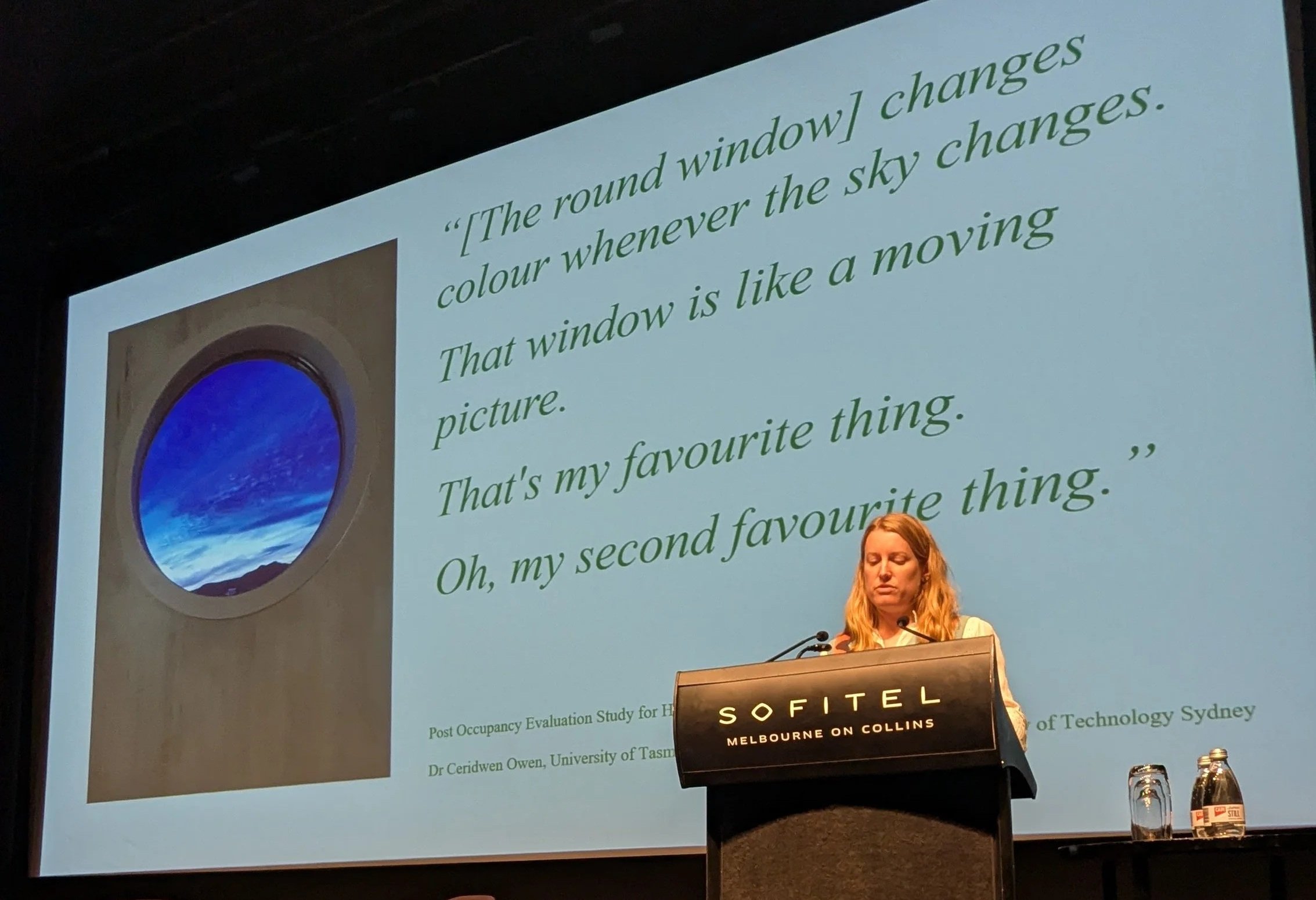
Emily Taylor at The Architecture Symposium
4. The economics of social value are still unresolved
The day opened with Clare Cousins and Tone Wheeler discussing the tension between for-profit and pro-bono practice, and it's a conversation that is difficult to settle. Tone argued that giving away time for free can undervalue our expertise, and proposed a shift from pro bono to what he called low bono: cost-rate fees, deferring fees for a percentage of a project's eventual profit, or a royalty model, rather than free labour. Clare's view was that contributing time and expertise is a genuine two way exchange. What you learn and build in project experience and relationships often leads to more work, not less.
Both were talking about the same underlying problem. Architects are absorbing the cost of social outcomes that the rest of the development economy isn't set up to fund. As Tone put it, there's enormous wealth generated in this industry that designers rarely see any of. I don't think there's a single right answer here, but it is certainly a conversation worth having openly rather than defaulting to either extreme.
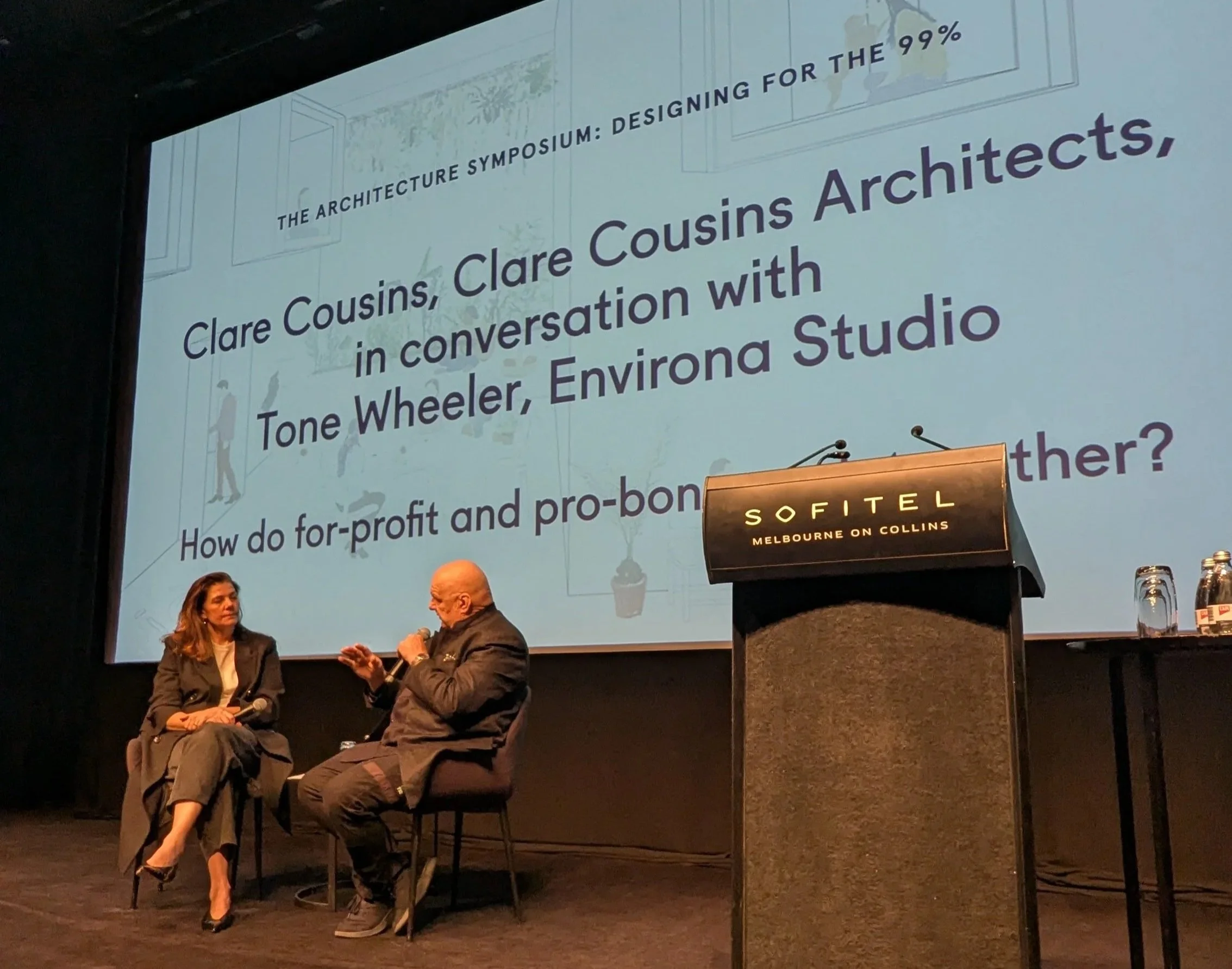
Clare Cousins and Tone Wheeler in conversation at The Architecture Symposium
None of the ideas from the symposium are entirely new on its own, but it is clear the architecture profession is working hard to reconcile their role and value as the context around us shifts (high housing demand, labour shortages, rising construction costs, housing affordability crisis, urban sprawl and heat island, inequality, climate change…). The core message from experiences shared across different parts of the industry, from custom homes, crisis accommodation, volume housing, and government policy, was that economic gains can be made at scale, and design decisions made early, and often invisibly, are the ones that determine whether housing actually works for the people living in it.